

La Siberia is the region of the Great Reservoirs, with miles and miles of freshwater shoreline and an ideal habitat for hundreds of bird species thanks to its combination of wetlands, meadows, and pastures. The plains in the south of the region contrast sharply with the mountain ranges in the north. It is undoubtedly a region waiting to be discovered, one that surprises with every visit.
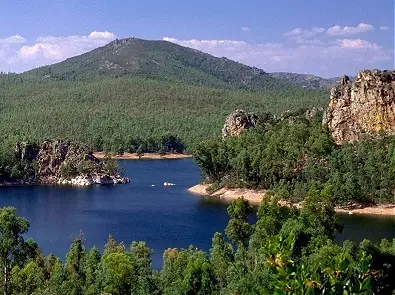
Landscape at the García Sola Reservoir (Puerto Peña)
The topography of the La Siberia region is clearly marked by the basins of the large reservoirs built in different sections of the Guadiana and Zújar rivers.
These reservoirs have transformed the natural habitats of the area and many species have adapted over the years to these new environmental conditions.
For cranes in particular, the combination of large expanses of freshwater, meadows, and pastures offers ideal conditions for overwintering. Throughout this area, which includes the Vegas Altas del Guadiana, La Siberia, and the La Serena region, more than 30,000 cranes can be seen during the winter months.
Comenzamos el recorrido en Navalvillar de Pela, una localidad con la estructura típica de la zona, situada junto a la Sierra de Pela.
Navalvillar de Pela is known for its famous San Antón Race, which is celebrated every January 16th.
North of Navalvillar de Pela lies the Moheda Alta Peri-urban Park, a prime example of the Extremadura dehesa (pastureland). During the winter months, it's an ideal spot for crane watching. The park features an interpretation center and several observation towers.
A visit to Moheda Alta can be planned to spend a whole day (or several) and enjoy its natural surroundings.
We continued on our way to Casas de Don Pedro, a beautiful village where the parish church of San Pedro Apóstol stands out, dating from the end of the 14th century and later reformed in the 16th-17th centuries, or the different hermitages of the town.
We crossed the waters of the Guadiana, Orellana reservoir basin, heading towards Talarrubias.
Talarrubias is one of the most important towns in La Siberia. It has the typical layout of towns in the province of Badajoz.
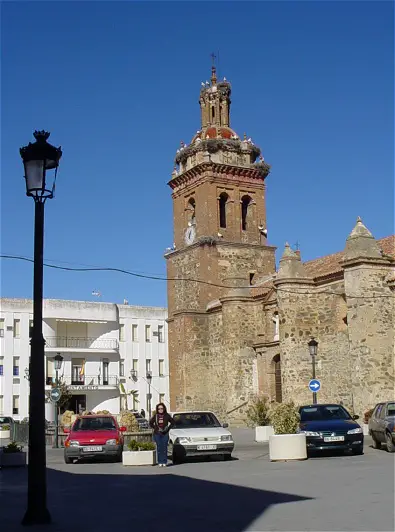
Tower of the Church of Saint Catherine of Alexandria in Talarrubias
Uno de los edificios más emblemáticos de Talarrubias es la Parroquia de Santa Catalina de Alejandría, mezcla de estilos gótico, renacentista , mudéjar y barroco.
Talarrubias, Puebla de Alcocer and Esparragosa de Lares are located between the Orellana reservoir, the gigantic La Serena reservoir and the Puerto Peña reservoir (García Sola), on a kind of peninsula or strip of land surrounded by fresh water.
This entire area is popular for numerous water sports and activities. Fishing is also a very important activity.
From Talarrubias, we can take a day trip to visit Siruela, in the southeastern part of La Siberia. In Siruela, we can see the 13th-century Church of Our Lady of La Antigua, the Convent of the Poor Clares, and the local hermitages.
If we have time we can take a tour of the small towns in this area of La Siberia: Garbayuela, Tamurejo and Baterno, right on the border with Ciudad Real, or Garlitos, the southernmost town in La Siberia.
We return to Talarrubias to head to Puebla de Alcocer.
What is most surprising about Puebla de Alcocer is its impressive 13th-century castle, later remodeled in the 15th century. It is situated on a hill above the town, from which you can see the entire La Serena valley and the reservoirs in the area.
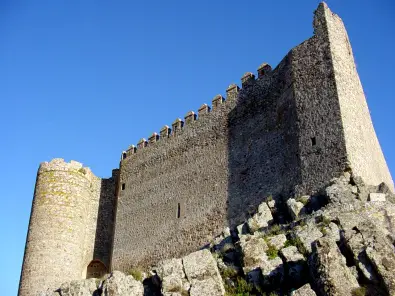
Puebla de Alcocer Castle
Within the town, you can see the Church of Santiago Apóstol (12th century), which was originally an Arab mosque. Also worth visiting are the Convent of San Francisco, several of the town's hermitages, and the numerous ancestral homes that give an idea of the town's importance, especially during the 17th century.
After visiting Puebla de Alcocer we continued the route towards Esparragosa de Lares, a beautiful town located just on the other side of the mountain range on which the castle sits.
In Esparragosa de Lares we can visit the church of Santa Catalina de Alejandría, from the end of the 15th century, or the numerous hermitages of the town.
Para finalizar esta primera parte de la ruta podemos bajar por la EX-103 en dirección a Castuera y una vez cruzado el cauce del Zújar nos desviamos a la derecha para pasar por la presa del embalse de La Serena en dirección a Orellana la Vieja.
The second part of the route through La Siberia will take us through the northeast, into the mountainous region. Continued on the next page.
Fuente: Viajar por Extremadura URL: https://www.viajarporextremadura.com/rutas-por-extremadura-la-siberia-322.htm